How to Organize Deep Kitchen Drawers Without Wasting Space

Updated: Aug 10

A deep kitchen drawer should make bulky items easier to reach. Yet many become a jumble of pot lids, containers, utensils, and bowls because depth alone does not create useful storage.
How we research recommendations: The products discussed here have not been personally tested by Amour Living unless clearly stated. We compared current product specifications, dimensions, materials, customer ratings and recurring feedback. Availability, ratings and product details can change, so recheck the listing and measure your cabinet before ordering.
Affiliate disclosure: This article may contain affiliate links. If you make a qualifying purchase through one of these links, Amour Living may earn a commission at no additional cost to you.
The simplest solution is to give each drawer one clear job, place the heaviest items low, and divide the space according to what you actually own. Do not start by buying a large organizer. Empty the drawer, measure it, and test the layout first. An organizer is worthwhile only if it stops movement, separates a repeated category, or turns genuinely unused height into accessible storage.
The short answer: Store like with like, keep everyday items in the easiest position, avoid mixed stacks, and use the smallest amount of structure needed to keep everything stable.
Why deep drawers become messy
Most deep drawers fail for one of four reasons: too many unrelated items share the space, the drawer is treated like a box rather than a working area, tall sides hide smaller objects, or products are purchased before the drawer is measured.
The depth can also tempt you to stack more than is practical. A neat pile is not useful if you must lift three heavy pans every time you want the one underneath. Good organization is not about fitting in the maximum number of objects. It is about reaching the objects you use without creating another mess.
Short on time? Jump straight to our recommendations ↓
Before you buy anything: measure the usable space

Measure the inside of the drawer, not the cabinet front. Record:
• Internal width at the narrowest point
• Internal depth from the inside front to the inside back
• Usable height below the cabinet frame or countertop
• The height and shape of the drawer sides
• Any hinge, screw, rail, or curved edge that reduces usable space
Then measure the largest item you want to store. Allow enough clearance for handles, lids, and the drawer to close without scraping. If you are considering an expandable or edge-supported product, check the manufacturer’s exact installation requirements rather than relying only on its advertised range.
The five-step method that works in almost any deep drawer
1. Empty the drawer completely. Wipe it out and remove objects that belong elsewhere.
2. Choose one main purpose. A cookware drawer and a food-container drawer need different layouts.
3. Group items by how you use them. Keep pans with compatible lids, containers with matching lids, and baking tools together.
4. Test the arrangement without organizers. Put frequently used items at the front or top and occasional items toward the back.
5. Add only the structure the trial exposed as necessary. That might be one bin, divider, peg, rack, or sliding upper tray.
How to organize deep kitchen drawers by what they hold
Learning how to organize deep kitchen drawers starts with matching each drawer to what you actually store inside it.
Pots and pans
Keep cookware close to the range if possible. Nest only pieces that can be lifted comfortably, and avoid a tall mixed stack. Place the heaviest pan at the bottom and keep frequently used pieces near the front.
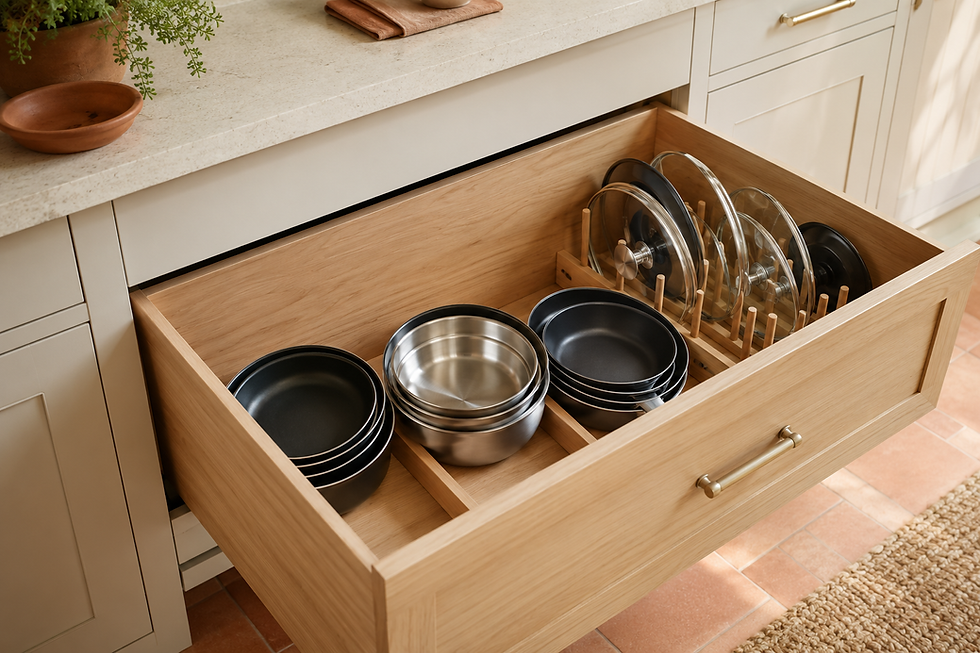
A vertical pan-and-lid rack can help when the drawer is tall enough and the handles clear the opening. It works best for skillets, lids, and cutting boards of similar shape. It is a poor choice for a shallow drawer, a weak drawer base, or a collection of very heavy cast iron.
Before buying, measure the rack at its tallest point with your pans in place. Also check whether the dividers lock firmly enough to prevent heavy cookware from leaning.
Plates and bowls
Deep drawers can be convenient for dishes because you lift items upward instead of reaching into an overhead cabinet. Keep matching plates or bowls together in low, stable stacks. A peg system can reduce sideways movement, especially in a wide drawer.

Peg organizers are not automatically space-efficient. Fixed spacing can create awkward gaps around mixed dish sizes, and some systems require a base to be trimmed. They suit people who want stable zones and are comfortable measuring carefully. Skip them if your dishes already sit securely or you change dish sizes often.
Cooking utensils
Deep utensil drawers work better with narrow individual bins than with one oversized insert. Group by activity: everyday cooking tools, baking tools, measuring tools, and occasional gadgets. Long utensils can sit lengthwise; small pieces need a shallow compartment so they do not disappear underneath.

Choose bins after measuring the drawer and lay out their footprints with paper first. This simple test shows whether an attractive set will leave unusable strips of space.
Food-storage containers
Store containers and lids as two linked groups. Nest containers by shape, but do not mix several incompatible systems. Keep lids upright in a narrow bin or divider so each one is visible. Remove containers without matching lids and replace badly warped pieces rather than letting them consume space.
If the drawer is tall, resist filling the upper half with another loose layer. A supported sliding tray can hold small lids or accessories while leaving the containers below accessible.
Baking supplies
Group cookie cutters, piping tools, measuring cups, and small molds in separate removable bins. A removable bin is useful because the entire baking group can be lifted to the counter. Store sheet pans, cooling racks, and cutting boards vertically only when the drawer height and dividers keep them stable.
Pantry ingredients
Deep drawers can work for packaged foods, but visibility matters. Stand packets upright, keep similar categories together, and label the top edge of opaque containers. Put regularly used foods near the front and keep backup stock behind them.
Avoid decanting simply for appearance. Decant only when the container improves freshness, visibility, or everyday use.
Best targeted solution for wasted vertical space

Best for: A genuinely deep drawer with small items floating above larger items, where a movable upper layer would improve access.
Why it stands out: The tray sits across the upper edges of a drawer and slides sideways, allowing access to storage underneath. According to YouCopia,it expands from 15 to 24 in long and measures approximately 7.1 in wide by 2.7 in high (38–61 × 18 × 6.9 cm), with no permanent installation required.
The practical advantage is not greater capacity at any cost. It is keeping shallow items—such as measuring tools, clips, or small lids—from disappearing among taller objects below.
Drawbacks and limitations: It requires compatible drawer edges and enough closing clearance. The tray occupies part of the opening, so it may frustrate users who regularly lift large items straight upward. It will not fix a drawer that is already overfilled.
Who should avoid it: People with narrow drawers, sloped or unusually thick drawer sides, minimal upper clearance, or bulky items that need the full opening.
Buying check: Measure the internal depth, usable width, drawer-edge shape, and height above the stored items before ordering. Confirm current dimensions, care instructions, rating, and recent reviews because listings can change.
Best budget option: correctly sized individual bins
A few simple bins are often more flexible than a full-width organizer. You can create a narrow zone for lids, a long zone for utensils, or a removable group for baking supplies without surrendering the whole drawer to one insert.
Choose bins with straight sides when space efficiency matters, non-slip feet or removable gel tabs when movement is a problem, and smooth surfaces that are easy to wipe. Buy by dimensions, not by the number of pieces in the set.
Who should avoid them: Anyone hoping bins will create more capacity. Bins divide space; they do not make an overfilled drawer larger.
Best no-buy solution
Before ordering an organizer, remove duplicates and move rarely used items out of prime kitchen storage. Then create temporary zones with containers you already own. A clean food-storage tub, shallow box, or sturdy spare container can test a category before you spend money.
Use the drawer for a week. Notice what shifts, becomes buried, or takes two hands to retrieve. That evidence tells you whether you need a divider, a lid bin, a pan rack, or nothing at all.
If deep drawers are only one part of your storage problem, our guide to organizing a small pantry without wasting space explains how to create practical zones, improve visibility, and avoid buying unnecessary matching containers.
Common mistakes to avoid
• Buying an organizer before measuring the internal drawer opening
• Combining unrelated categories because there appears to be spare room
• Building tall mixed stacks that must be dismantled to reach one item
• Adding bins that create narrow, unusable gaps around the edges
• Loading heavy cookware or dishes without checking the drawer hardware
• Using a vertical rack without checking handle and closing clearance
• Keeping duplicates or lidless containers simply because they fit
A simple maintenance routine
Good drawer organization should not require a weekly project. When unloading the dishwasher, return items to their assigned zone. Once a month, remove obvious strays. Every six months, check whether the drawer still matches how you cook and whether any organizer is cracked, loose, or wasting space.
If the drawer repeatedly becomes messy, do not assume you need more containers. The usual cause is an unclear category, too many objects, or a layout that makes the most-used item hard to reach.
Frequently asked questions
What should go in deep kitchen drawers?
Deep drawers are well suited to pots and pans, dishes, food-storage containers, baking tools, and packaged pantry foods. Give each drawer one main purpose and keep the heaviest items low.
How do I stop items moving in a deep drawer?
Use a non-slip liner, correctly sized bins, adjustable dividers, or a peg system. Choose the lightest solution that keeps the category stable without creating wasted gaps.
Are peg systems worth it for dishes?
They can be useful in wide drawers where plates and bowls slide, but they require careful measurement and may leave odd spaces around mixed dish sizes. If your stacks already remain stable, a peg system may add cost without solving a real problem.
Can I store cast-iron pans in a drawer?
Only if the drawer base, runners, and installation are rated for the combined load. Check the cabinet specifications rather than assuming a deep drawer is heavy-duty.
How can I use the empty space at the top of a deep drawer?
A compatible sliding upper tray can create a shallow second level while preserving access below. Measure the internal opening, edge shape, and closing clearance before buying.
Should every deep drawer have an organizer?
No. Large pots or stable stacks of matching bowls may work better without one. An organizer earns its space only when it improves access, visibility, or stability.
Final advice
The best deep-drawer system is not the one with the most compartments. It is the one that lets you reach the item you need without lifting, digging, or rearranging everything around it.
Start with one purpose, measure the usable space, and test the layout with what you already own. If a specific problem remains, choose the smallest organizer that solves it. That approach creates a calmer kitchen—and avoids turning organization into another expensive collection of things.

Comments