How to Store Leftovers So They Get Eaten, Not Forgotten


Affiliate disclosure: This article may contain affiliate links. If you make a qualifying purchase through one of these links, Amour Living may earn a commission at no additional cost to you.
How we research recommendations: Amour Living has not personally tested the products discussed unless stated otherwise. We compare current specifications, materials, ratings, and recurring customer feedback. Product details, ratings, and availability can change, so recheck the listing before ordering.
How to store leftovers safely and actually use them is simple: refrigerate food promptly in shallow, covered containers, write the date on each one, and keep the next few meals where you can see them. That protects food safety first—and makes leftovers far more likely to get eaten before they disappear behind new groceries.
If leftovers usually become a mystery at the back of your refrigerator, the problem is rarely a lack of containers. It is usually that the food is too deep, too hidden, or too vague to choose when you are hungry. A few small habits fix that better than buying a cupboard full of matching boxes.
How to Store Leftovers Safely: Start With Safety, Not Organization
Perishable leftovers should go into the refrigerator within 2 hours of cooking, or within 1 hour if the temperature is above 90°F (32°C). The refrigerator should be 40°F (4°C) or colder. For quicker cooling, divide large amounts into smaller, shallow containers rather than leaving them in one deep pot.
For most cooked leftovers, the usual refrigerator window is 3 to 4 days. That is a useful planning rule, not a reason to trust food that has been left warm too long. When in doubt about time or temperature, do not taste it to check—discard it.
Important: A pretty label never makes food safe. Date labels are there to help you use food on time, not extend the safe storage window.
Why deep containers make leftovers easier to waste
A deep container can be useful for a large batch, but it is often poor for cooling and poor for visibility. Food gets buried beneath a lid, becomes one of many identical shapes, then needs effort to inspect. Shallow portions cool faster and make the meal obvious at a glance.
Use containers that match the job
You do not need one perfect container set. You need a few reliable sizes that suit the food you genuinely save. A shallow rectangular container works well for a single meal or cut vegetables. A slightly larger one suits a family portion. Clear sides are helpful because they show what is inside before you commit to opening it.
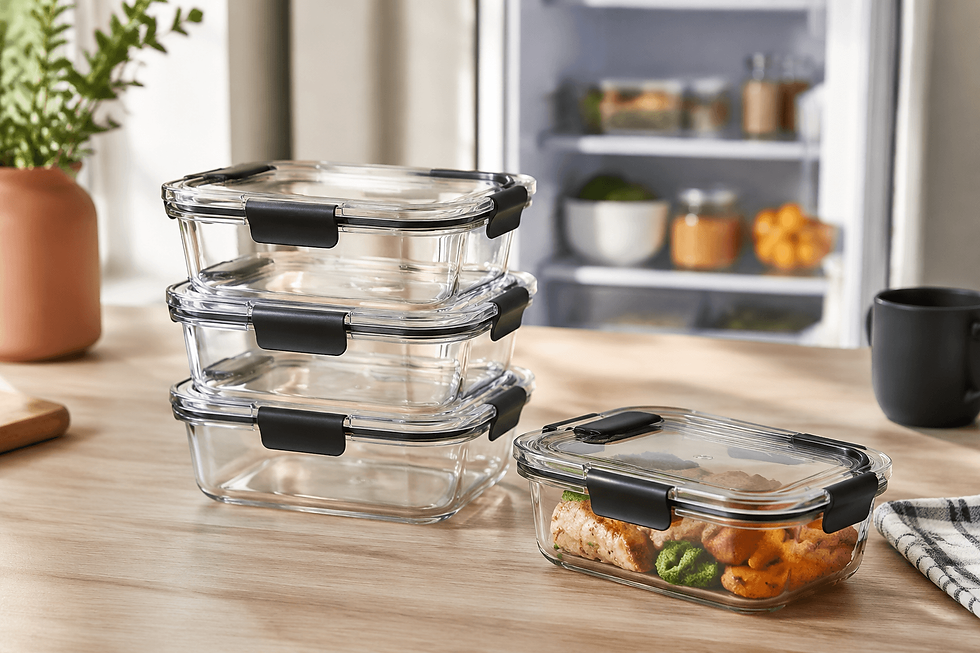
Our clearest researched choice: Rubbermaid Brilliance Glass 3.2-cup containers are a sensible option for households that want a durable, clear, stackable container for individual leftover portions. The current Amazon listing shows a 4.6-star average from more than 14,000 ratings and states that the glass bases are oven-safe up to 450°F (232°C); lids must be unlatched for microwave reheating.
They are not the best choice for everyone. Glass is heavier than plastic, can cost more, and creates no benefit if you already have a set of leak-resistant containers that stack well. Do not replace usable containers simply for a more uniform look.
The small labeling habit that changes the system

Write two things on each leftover: what it is and the date it went into the refrigerator. A small washable label, removable tape, or a marker on the lid is enough. “Chicken chili — Tue” is far more useful than a container you need to open and guess at.
Skip complicated tracking systems. The label only needs to answer the question you will have later: What is this, and how soon should I decide whether to eat or freeze it?
Give leftovers one visible home
Choose a shallow tray or one front section of an eye-level shelf as your use-first zone. Every dated leftover goes there, not wherever there happens to be space. This is the leftover version of the visibility system in our guide to organizing your refrigerator so food does not get forgotten.
Keep the zone small enough that it cannot become storage for everything. Its job is to show what should be eaten next. If there are more leftovers than fit in the zone, decide straight away which ones are tomorrow’s meals and which should be frozen in portions.
Do a 30-second check before you shop

Before writing a grocery list, look at the use-first zone. Move the item you will use next to the front. Add a leftover meal to your plan before buying ingredients that would duplicate it. This tiny reset protects your food budget more effectively than another organizer.
5-minute leftover system
1. Within the safe cooling window, divide food into shallow, covered portions.
2. Write the food name and date on each portion.
3. Put the next few portions together in your eye-level use-first zone.
4. Freeze what you will not realistically eat within the safe refrigerator window.
5. Before your next shop, check the zone and plan one leftover meal.
That is enough. The aim is not to make leftovers look curated. The aim is to make the safest, easiest choice also the one you are most likely to make.
What to avoid
· Leaving a big pot on the counter until it is completely cold. Divide it into shallow containers and refrigerate within the safe time window instead.
· Putting unlabeled leftovers behind newer food. Use the front, eye-level zone first.
· Saving every small amount. Keep portions that can become a real meal, lunch, or ingredient—not containers that create uncertainty.
· Assuming a sniff test proves food is safe. Time and temperature matter more than smell.
FAQ
How long do leftovers last in the fridge?
Many cooked leftovers are best used within 3 to 4 days when refrigerated at 40°F (4°C) or below. Specific foods can vary, so use the FoodSafety.gov cold-storage chart for details.
Can I put warm leftovers straight into the refrigerator?
Yes. The Food and Drug Administration advises dividing large amounts into shallow containers for quicker cooling; do not wait for food to cool completely on the counter.
Should I use glass or plastic containers?
Either can work. Choose containers that are intact, covered, easy to clean, and easy for you to see and stack. Glass can be useful for staining foods and oven reheating when the manufacturer allows it, but it is heavier.
Related reading

Read our guide to organizing your refrigerator so food does not get forgotten.
For produce-specific timing and crisper-drawer guidance, read how to store fresh produce so it lasts longer.


Comments